
"Indian markets (are) well placed to absorb the US Fed rate hike. Gradual approach in future increases augurs well for emerging markets," Economic Affairs Secretary Shaktikanta Das has tweeted.

The improving earnings and economic outlook has titled the scales back in favour of Indian equities this year, reports Pavan Burugula.


Among the Sensex firms, Larsen & Toubro, UltraTech Cement, JSW Steel, Titan, Bajaj Finance, Wipro, Tech Mahindra and Nestle were the major laggards. Maruti, Power Grid, Axis Bank, State Bank of India, NTPC, HDFC Bank, ITC and IndusInd Bank were the gainers.

The stock market, the Survey felt, had run away from underlying real economy indicators and asked if this indicated rational confidence or irrational exuberance.

Do not, however, enter expecting quick returns.
Predicting a gloomy economic future, a top United Nations trade and development agency today said the governments still have a long way to go to tide over the financial crisis.

Many CEOs said they plan to give special leave to women employees so as to encourage their participation in the workforce.
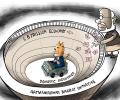
The Indian economy is on the path of a durable recovery on the back of conducive monetary and credit conditions, the global headwinds notwithstanding, said a Reserve Bank of India (RBI) article on the state of the economy. Domestically, there have been several positives on the COVID-19 front, in terms of reduced infections and faster vaccinations, the article published in the RBI Bulletin November 2021 added. The Indian economy, the article said, is clearly differentiating itself from the global situation, which is marred by supply disruptions, stubborn inflation and surges of infections in various parts of the world.

Reflecting subdued global economic growth, India's outward foreign direct investment (FDI) fell by 33.3 per cent sequentially to $1.21 billion in August, compared to over $1.82 billion in July.

Silver, which is currently trading at Rs 68,453 per kilogram, has appreciated 21.7 per cent over the past three months. Investors, however, shouldn't get carried away by its recent performance and put their money in it. Instead, they should evaluate its pros and cons and then take a considered decision based on their risk appetite.

MHCV sales' grew by 9% to 5,033 units over September 2020 and 3% over October 2019, the first month registering growth over the previous year.
In a year that saw inflation touching a 13-year high of 12.82 per cent in August, the 150 million cases beer market grew by 15 per cent, according to All India Breweries Association figures. The wine segment, which has a total market size of around 1.5 million cases, posted even a higher growth rate of 30 per cent, as per International Wines and Spirits Record, while other alcoholic beverages, with a market size of 190 million cases, grew at 15 per cent.

The outlook is improving and that mostly reflects the fact that the new government has pledged to prioritise economic reforms.

'India is an equity market with a breadth and depth of companies to invest in.'
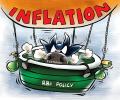
"We have to stand in readiness to go beyond keeping Arjuna's eye to deploying policy instruments, if necessary" to contain inflation, said Reserve Bank Governor Shaktikanta Das on Thursday. Headline consumer price index-based inflation projection for the second quarter of 2023-24 has been revised up substantially, primarily due to the price shock from vegetables, at 6.2 per cent by the RBI form 5.2 per cent estimated in June. Unveiling the bi-monthly monetary policy, Governor Das said the moderation in headline inflation to 4.6 per cent in the first quarter of 2023-24 was in line with the projections set out in the June MPC meeting.
Weaker demand for Indian exports and higher financing costs will lead to a deceleration in India's gross domestic product (GDP) growth rate to 7.9 per cent in 2008, the International Monetary Fund has said.The IMF's growth projections for India are in line with other estimates, including that of the Asian Development Bank, which pegged the 2008-09 growth at 8 per cent.

Indian economy is expected to clock an average growth rate of 6.7 per cent till 2026-27 fiscal driven by domestic consumption, S&P Global Ratings senior Economist (Asia Pacific) Vishrut Rana said on Wednesday. He said the economic growth in the current fiscal is expected to come in around 6 per cent, lower than 7.2 per cent clocked in 2022-23. "We are seeing some headwinds from the trade side which is affecting activity and that is one of the factors that is affecting growth this year," Rana said at a webinar.
India's economic condition is just a notch above that of Greece. The next phase could be of a "sovereign default" similar to Greece, said Arun Jaitley, Leader of Opposition in Rajya Sabha.
Inflation at 6 per cent was a matter of concern in the evolving macro-economic outlook and the Reserve Bank of India fears that consumer prices could be even higher at 7 to 8 per cent.
The cut is being seen as an emergency measure to boost the US economy.

The World Bank on Sunday said the coronavirus outbreak has severely disrupted the Indian economy, magnifying the pre-existing risks to its outlook. In its 'South Asia Economic Update: Impact of Covid-19', the World Bank estimated the Indian economy to decelerate to 5 per cent in 2020 and projected a sharp growth deceleration in fiscal 2021 to 2.8 per cent in a baseline scenario.

In 2016, one in two companies is planning to increase head count with hi-tech, shared services and life sciences leading the pack

It was August 2007. Tata Steel was turning 100. Jamshedpur, its hometown, had an air of celebration. The line-up for the special event included the launch of Air Deccan's commercial flight connecting Kolkata and Jamshedpur, and release of Russi Lala's new book, Romance of Tata Steel. There was also the screening of The Spirit of Steel, a 20-minute documentary directed by Zafar Hai showcasing Tata Steel's legacy, and a corporate anthem penned by Javed Akhtar and composed by Shankar, Ehsaan and Loy.

Eminent economist Arvind Panagariya has said India is on the cusp of returning to a high growth trajectory and voiced confidence that the country will become the world's third-largest economy by 2027-28. Currently, India is the fifth largest economy "so it's another five years.We are already in (the year) 2023. "So 2027-28, India should be the third-largest economy," Panagariya, Columbia University Professor and former Vice Chairman of NITI Aayog, told PTI in an interview in New York.

The IMF said global growth is projected to reach 3.9 per cent in 2018 and 2019, in line with the forecast of the April 2018 WEO, but the expansion is becoming less even, and risks to the outlook are mounting.
Best monsoon in six years has spurred rural growth but urban scenario grim.

The new Samvat 2080 is viewed as a year of hope for industrial and precious metals. A key reason is the expectation of US interest rates peaking, followed by a reduction in the coming months. Regarding crude oil, its trajectory depends more on how the situation unfolds in West Asia.
In spite of a recent devastating money/monsoon.htm drought, India's economy has fared well and should enjoy solid growth this year and next, the IMF said.

The survey also shows a majority in favour of ousted leader Boris Johnson, with 55 per cent saying that Tory MPs were wrong to effectively force him to resign and 40 per cent saying they were right.

The decisive election victory for the Narendra Modi-led National Democratic Alliance has created a conducive environment for policy actions and should help in economic recovery, Reserve Bank of India Governor Raghuram Rajan said on Tuesday.
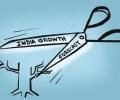
India's real GDP growth will decline marginally to 6.3 per cent in 2024 from the 6.4 per cent estimated for 2023, an American brokerage firm said on Monday. The next calendar year will be of two halves, wherein the government spending before the upcoming General Elections will be the key driver for growth, while after the elections, it will be the re-acceleration in investment growth, especially from the private sector, Goldman Sachs said in a report. From a fiscal year perspective, the brokerage said it expects growth to accelerate to 6.5 per cent for FY25 from the 6.2 per cent it has projected for the ongoing FY24, it added.
Fund raises growth forecast to 8.3% in 2006.

Retail inflation slowed to 4.29 per cent in April from 5.52 per cent in March, mainly due to easing food prices, government data showed on Wednesday. The Reserve Bank mainly factors in the retail inflation based on Consumer Price Index (CPI) while arriving at its monetary policy. As per the data released by Ministry of Statistics and Programme Implementation, inflation in the food basket was 2.02 per cent in April, down from 4.87 per cent in the preceding month.

HDFC was the top loser in the Sensex pack, shedding over 2 per cent, followed by Axis Bank, Bharti Airtel, M&M, Reliance Industries, ICICI Bank, IndusInd Bank and Titan.
